
Editorial
seeing sound, hearing time:Inside Hamburger Bahnhof's Ryuichi Sakamoto Retrospective
Interview by Ligia Boueres, founder of BlueLobster Art
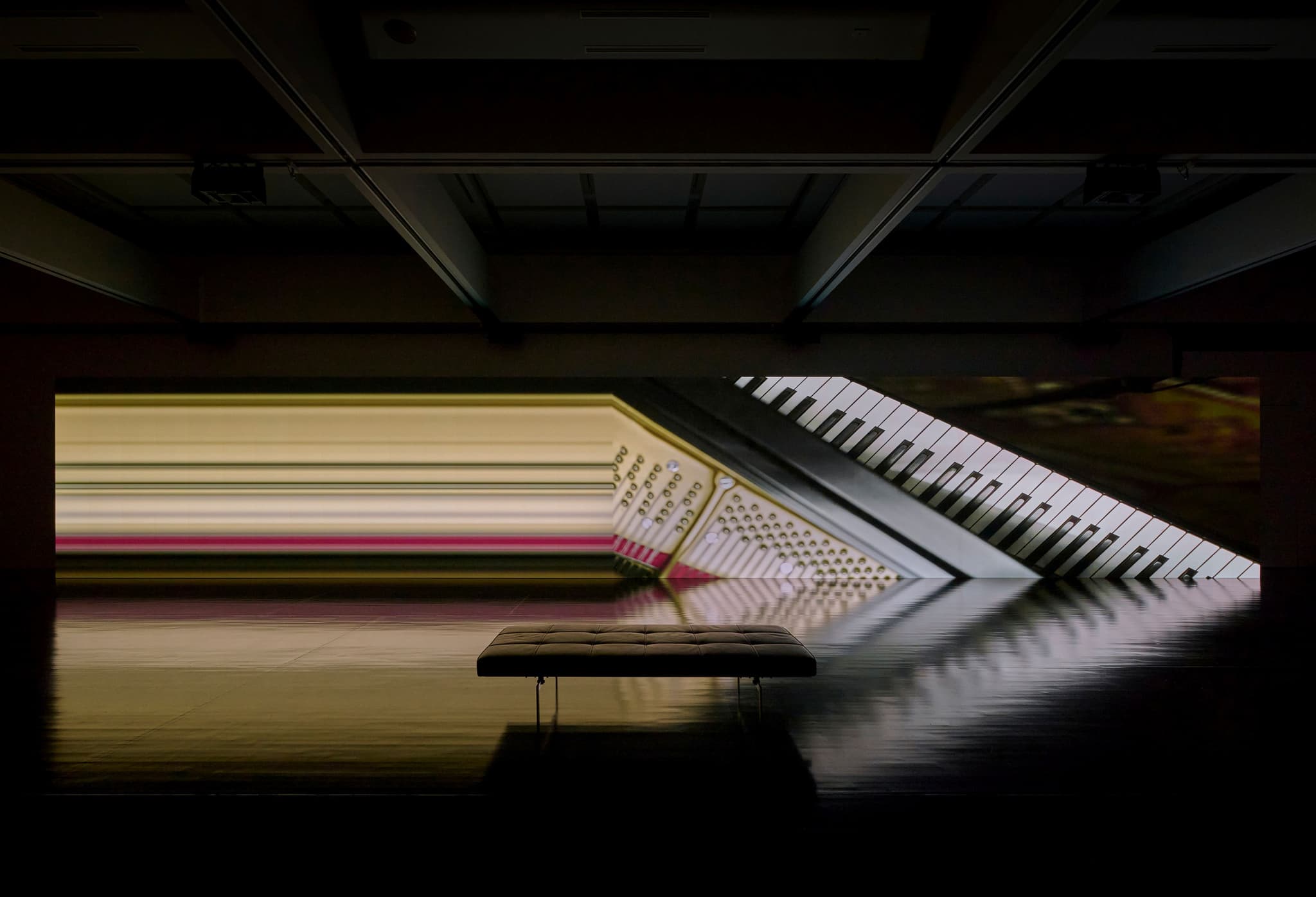
Ryuichi Sakamoto spent his career resisting categories, moving between film scores, pop records, and installation work without ever settling into one identity. In Berlin, Hamburger Bahnhof's Ryuichi Sakamoto exhibition, seeing sound, hearing time, continues that resistance in a more literal way. Europe's first major retrospective of his work refuses to be heard the way music is usually heard. There is no stage, no set start time, no fixed sequence of movements. Instead, sound is built directly into the architecture of the museum's Rieckhallen, spread across roughly 1,500 square meters, moving through the rooms the way light moves through a building over the course of a day.
The exhibition brings together seven works in five large-scale installations, co-curated by Ingrid Buschmann of Hamburger Bahnhof and Sachiko Namba, who staged the show's original, larger presentation in Tokyo. Among the pieces on view is IS YOUR TIME, built around a piano destroyed in the 2011 tsunami and wired to real-time seismological data, alongside works from Sakamoto's async, made with longtime collaborator Shiro Takatani and filmmaker Apichatpong Weerasethakul, and two films by Carsten Nicolai set to music from 12, Sakamoto's final album. As the exhibition's curatorial concept frames it, Sakamoto “continually redefined the boundaries between sound, film, performance and visual art,” and the show places that intersection “at its centre, a hallmark of Hamburger Bahnhof since its founding 30 years ago.”
Ligia Boueres, founder of BlueLobster Art, attended the press preview and spoke with Sachiko Namba, curator, Tokyo; and with Dr. Sam Bardaouil, co-director of Hamburger Bahnhof, about what it means to put a musician's life's work inside a museum instead of a concert hall.
Interview I
Sachiko Namba, curator
BlueLobster Art: Why does this body of work belong in a museum, not a concert hall?
Sachiko Namba: Ryuichi was always interested in how to install music in a space like this. Usually when you have music, there's a beginning and an end, a performance held at a certain time, for a certain length. He wanted to challenge that notion of music tied to time. He wasn't interested in a linear, single development. He was drawn to something more like a dream, where one moment can hold a hundred years. That dream logic doesn't really have a beginning or an end, and installation is the format that makes that possible. The audience can come and go whenever they like, stay as long as they want. That gives you a different kind of freedom to experience music.
BlueLobster Art: What does that freedom actually feel like inside the exhibition?
Sachiko Namba: Because the sound is installed three-dimensionally, when you walk through a room you can feel it travel from one point to another. That's very different from sitting in a concert hall. I'd tell visitors to notice how the sound is installed, how it moves through each room, and how their own movement, where they stand, where they walk, becomes part of that. Ryuichi was interested in sound as something physical: it vibrates the air and reaches your eardrum, even though you can't see it. He wanted to make the invisible visible, the inaudible audible. It's a very sensory, very personal experience. I want each person to find their own way of appreciating it.
BlueLobster Art: If you could leave visitors with one thing, what would it be?
Sachiko Namba: I don't want to give an answer, only a question. Ryuichi was interested in the process of creating, not in how the result would be received. Once the work is finished, it's up to the audience. In a way, that makes the audience a collaborator, curating the experience alongside us. That's a very new kind of experience, and I find it a really open, generous attitude.
BlueLobster Art: How did the exhibition make its way from Tokyo to Berlin?
Sachiko Namba: It came by invitation. The directors saw the exhibition when it was staged in Tokyo, the largest presentation of the work, with twelve installations, and asked directly to bring it to Hamburger Bahnhof. From there I started working with Ingrid, and we had to think about what would work best here, given the museum's corridor-like structure and a different audience.
BlueLobster Art: What do you hope Berlin brings to the work?
Sachiko Namba: Berlin has such a strong relationship with music, the electronic scene is very active, but also classical and experimental. When we showed this in Tokyo, we didn't expect so many teenagers to come. Many of them didn't really know Ryuichi as an artist, they found him through social media instead, and they really connected with the work. I hope the same happens here, that a younger generation discovers him for the first time through this.
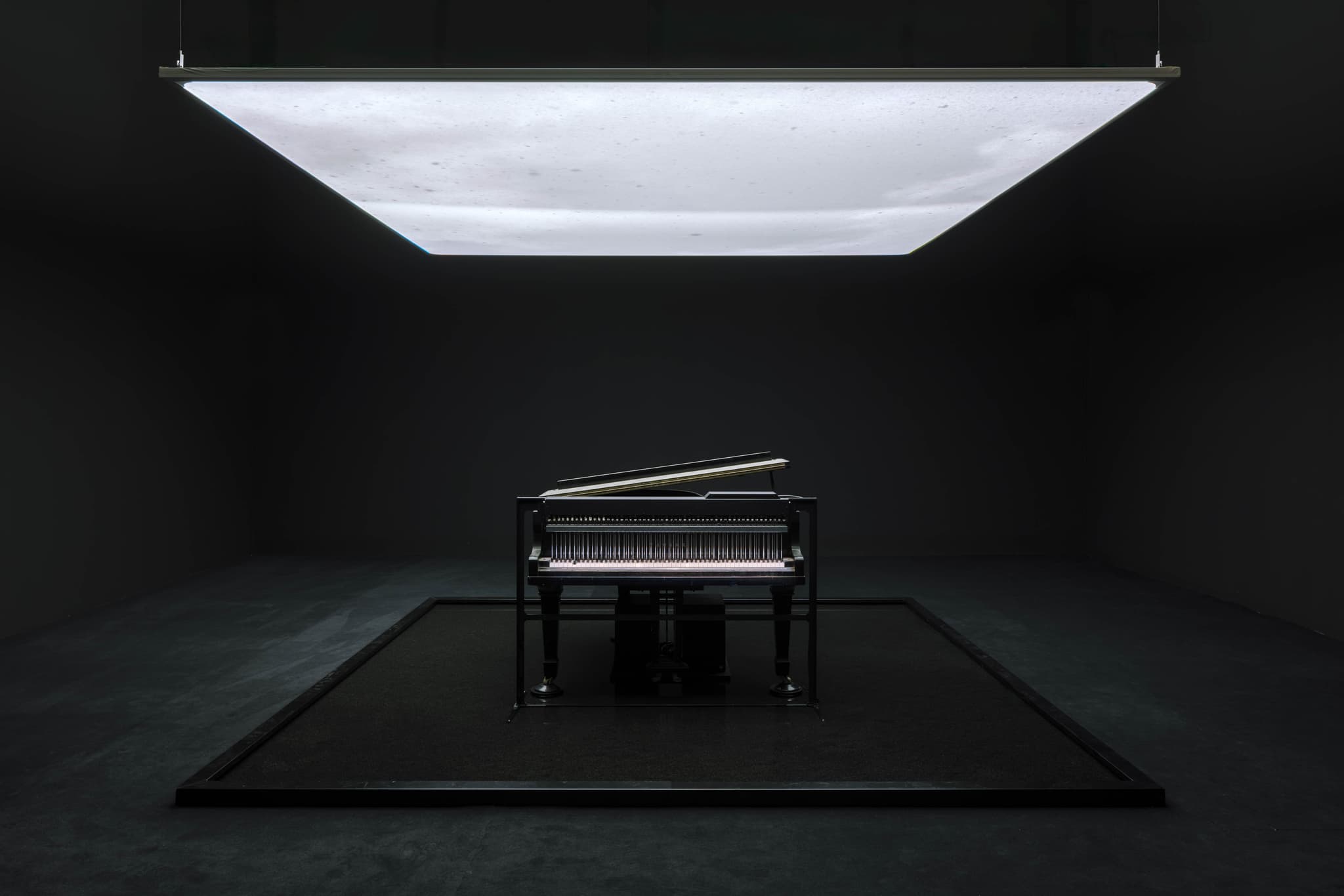
Ryuichi Sakamoto | seeing sound, hearing time, Ausstellungsansicht / Exhibition view, Hamburger Bahnhof – Nationalgalerie der Gegenwart, 11.9.2026 – 20.6.2027, IS YOUR TIME, 2017/2024, Ryuichi Sakamoto with Shiro Takatani © The Estate of Ryuichi Sakamoto / KAB Inc, Foto: Jacopo La Forgia
Interview II
Dr. Sam Bardaouil, co-director of Hamburger Bahnhof
BlueLobster Art: This is the major Sakamoto retrospective in Europe. Why is it happening here, and why during the museum's 30th anniversary? Was the timing planned, or did it come together by chance?
Sam Bardaouil: The way many things happen, there's an element of chance and an element of planning. Till and I met Ryuichi Sakamoto in person back around 2016 or 2017, in Tokyo. At the time we were responsible for the Montblanc Cultural Foundation, which gave an annual arts patronage award to people who had contributed to the art world in different ways, and we gave that award to him. It was a beautiful ceremony. He brought children from a music school he had started in Fukushima after the disaster, and they played music together. It was incredible, such a warm, open, gentle-souled person, and at the same time very sharp and very precise. We had been following his music for a long time already, but that's when we learned more about how he was thinking about music as installation. When we started working at Hamburger Bahnhof, it was always on our mind to do something with an artist bridging visual art and music, and given our collection's own history with sound art and time-based work, he was the perfect choice. For the 30th anniversary, every show has a reason, a connection to the museum's programs, history, and values. This is one of the clearest expressions of that.
BlueLobster Art: What do you hope visitors leave this exhibition with?
Sam Bardaouil: I think the world moves so fast right now. We're constantly bombarded with images and sounds, on social media, everywhere, and we don't really process any of it anymore. It just becomes an accumulation of noise. This exhibition invites you to slow down, to let your body receive the sound instead of just seeing it, which is really what the title of the show is about. I hope it makes people change gears, stop running for a moment, and remember the value of giving something the attention it needs to actually do its work on you. Some contemplation. Some physical slowing down. That's what I hope for.